Last month, I was debriefing with a CEO who said something that resonates with me and so many other teams:
“Brandon, we’ve got great procedures, great people, and solid resources, but when things get complex, my team freezes. How do we build confidence and execute in uncertainty?”
It reminded me of my early days as a fighter pilot. Those times when uncertainty hit—system failures, weather, emergencies, combat—all complex variables and high stress producing environments.
And just like yours, these are environments the human mind isn’t designed to thrive in.
That’s where Human Factors Leadership comes in.

The Reality of Leading in Complexity
Most leadership training prepares you for predictable scenarios. But real leadership happens in the gray areas—when:
- Multiple priorities compete for attention
- Information is incomplete or contradictory
- Stakes are high and time is short
- Your team looks to you for direction you don’t have all the answers
Sound familiar?
3 Tools from the Cockpit for Your Leadership Toolkit
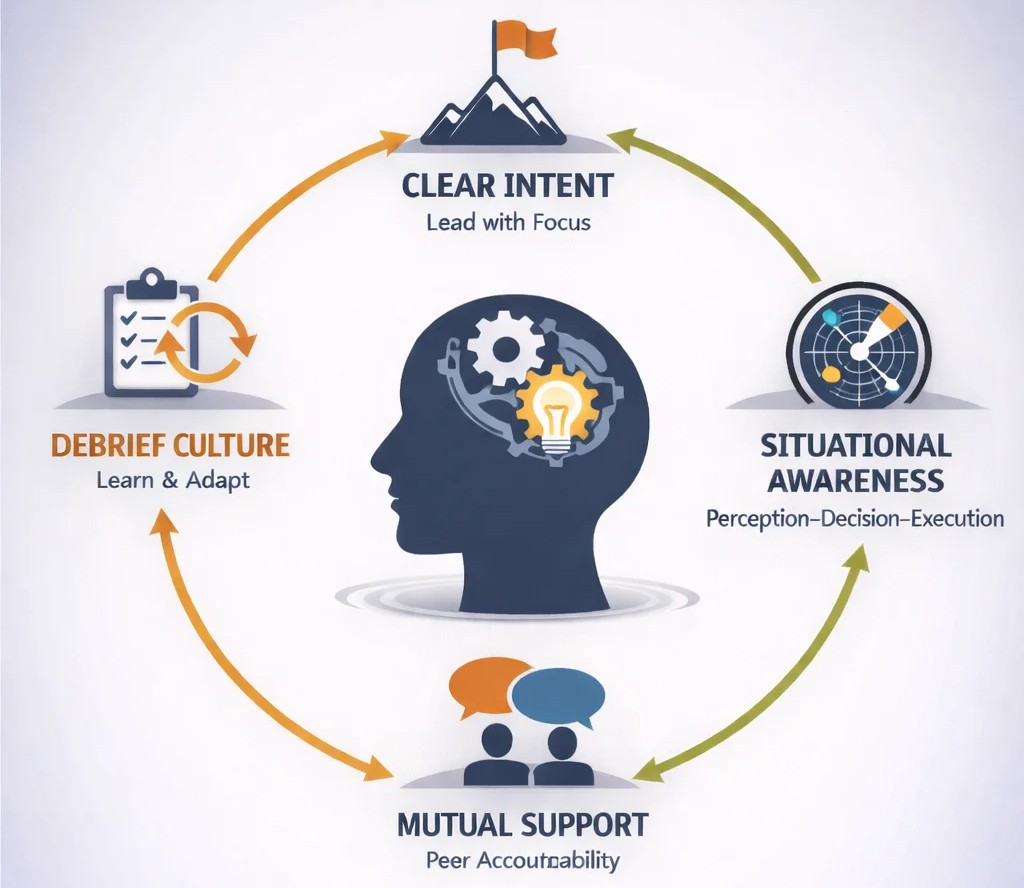
Tool #1: Clear Intent – Your Team’s North Star
What it is: Clear Intent provides laser focus for your team and serves as a high-definition picture of what success looks like. It helps narrow their focus to the most important priorities while empowering them to operate autonomously.
How leaders implement it:
- Define the Clear End State: Paint a vivid picture of what success looks like
- Identify Top 2-3 Priorities: What are the critical few cornerstones that drive success?
- Enable Autonomous Operation: Give teams the clarity to make decisions aligned with the end state
Example: Instead of “We need to cut costs, “provide Clear Intent: “End state: We emerge from this economic downturn financially stronger and positioned for aggressive growth. Top priorities: (1) Reduce operational expenses by 15% without compromising quality, (2) Maintain customer satisfaction above 90%, (3) Preserve our top talent. This clarity lets you make decisions that serve our bigger picture.”
Tool #2: Mutual Support – The Wingman Concept
What it is: Mutual Support creates peer accountability with deep trust between team members. It’s the wingman concept of supporting—not competing—where team members have each other’s backs.
How to build it:
- Start with Leadership: Model transparency and trust from the top
- Establish Clear Expectations: Make supporting teammates a core value, and establish CLEAR roles.
- Create Safe Challenge: Enable team members to respectfully question decisions
- Focus on Team Success: Reward collective wins over individual achievements, and BUILD camaraderie…the life-blood of mutual support.
Real example: In a broader WHO surgical checklist study, which emphasized team communication and speaking up (core elements of Mutual Support), major surgical complications dropped by 36% and deaths by 47%.When teams create environments where any member can voice concerns and support each other—regardless of hierarchy—the impact on performance is measurable and dramatic.
Tool #3: Situational Awareness – The Decision-Making Engine
What it is: Situational Awareness drives effective decision-making through a three-step process: PERCEPTION → DECISION →EXECUTION.
The framework:
- PERCEPTION: What’s actually happening? (Stop, think, and gather real-time information)
- DECISION: What’s the best course of action? (Analyze options against your Clear Intent, available resources, and team members)
- EXECUTION: How do we implement effectively? (Act decisively and autonomously with Mutual Support)
Implementation: Before major decisions, walk your team through all three phases. Ask: “What do we perceive is happening? What decision does this information support? How will we execute with mutual support?”
Example: A project manager notices her team missing deadlines (PERCEPTION). She gathers information: workload has increased 40%,two key team members are overwhelmed, and client expectations weren’t clearly communicated. She analyzes this against the project’s Clear Intent—deliver quality work on time while maintaining team wellbeing (DECISION). Her decision: redistribute workload, bring in temporary support, and reset client expectations with a revised timeline. The team executes with Mutual Support—senior members mentor junior staff, everyone cross-checks each other’s work, and they maintain open communication about roadblocks (EXECUTION).

The Debrief: Your Secret Weapon for Team Performance
Here’s what separates high-reliability organizations from everyone else—they debrief everything with a tone of accountability focused on team performance.
Not just failures. Everything.
The Real Debrief Framework:
- What happened? (The facts, without blame or emotion)
- WHY did it happen? (The ultimate causal factors and root causes)
- Lessons Learned for the team (How do we improve going forward?)
This isn’t a “blame and train” approach—it’s “learn and grow” focused on elevating team performance. The magic happens when you create psychological safety where people can share truth under a tone of accountability, not punishment.
Example: After a project delay, instead of asking “Who dropped the ball?” ask “What happened that led to the delay? Why did our systems allow this to occur? What can we learn and/or change to prevent this pattern in future projects?”

Your Next Action
Pick ONE tool above and implement it this week:
- Clear Intent: Define a high-definition end state for your next major initiative and identify the top 2-3 priorities that will get you there
- Mutual Support: Model transparency with your team and establish one new way team members can support each other
- Situational Awareness: Use the PERCEPTION → DECISION → EXECUTION framework for your next important decision
- BONUS: Pick one task or project from your team and lead an open and honest debrief with a tone of accountability. NOT an individual performance evaluation, but a TEAM performance improvement process.
Remember: Complex environments don’t require complex solutions. They require disciplined application of simple, proven tools that create focus, trust, and effective decision-making.
A Final Thought
In aviation, we have a saying: “Superior pilots use their superior judgment to avoid situations that would require their superior skills.”
The same applies to leadership. Use these Human Factors tools to build teams that make uncertainty manageable—before the complexity hits.
Lead Good and Fly Safe!
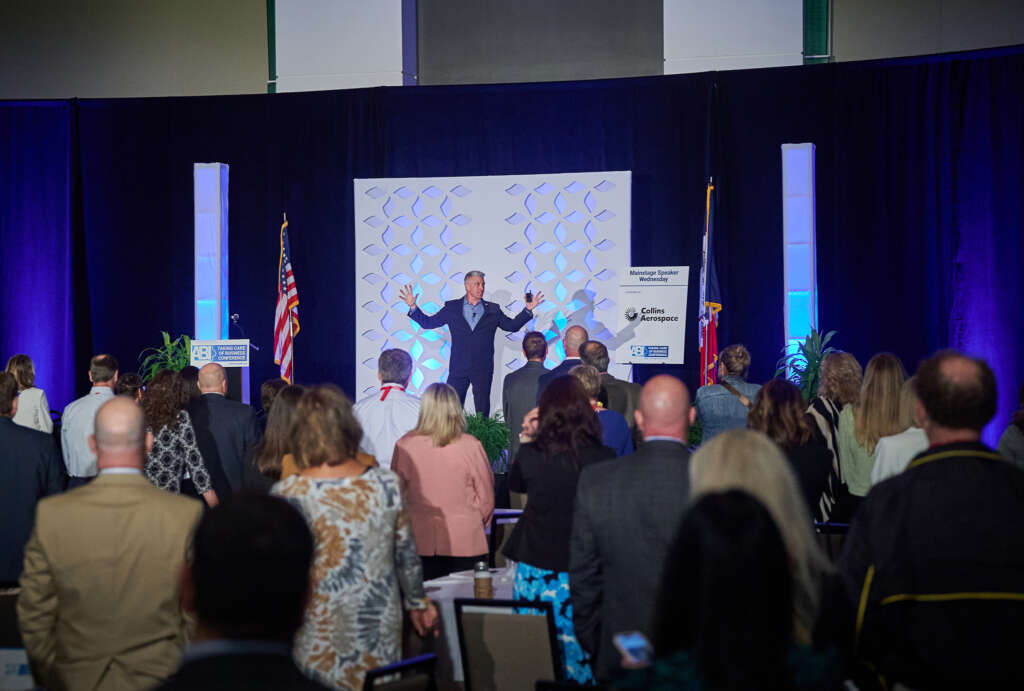

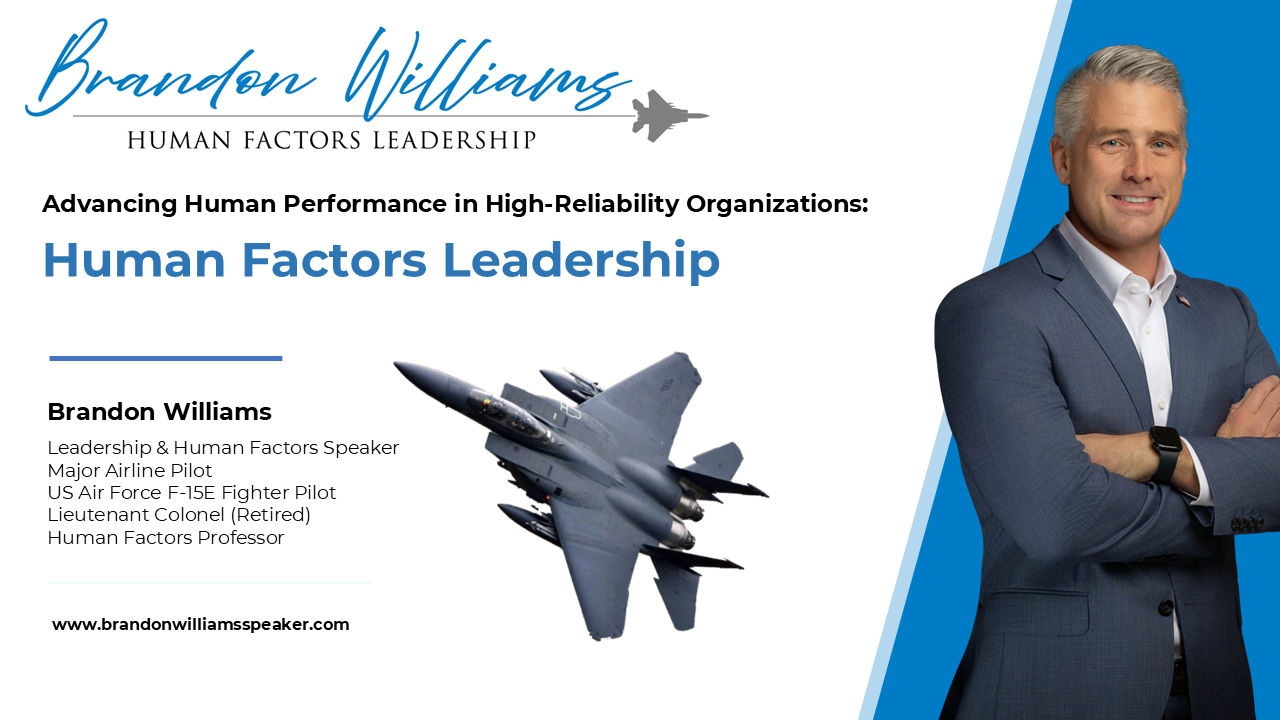
Brandon Williams is a seasoned airline captain, human factors professor, and former U.S. Air Force Fighter Pilot, Lieutenant Colonel, and Safety Officer. With over 20 years of experience leading teams in high-risk, high-performance environments, he brings unmatched credibility to the world of leadership, safety, and operational performance.
As an expert in Human Factors, Brandon equips leaders and teams with practical tools to lead with clarity, foster psychological safety, and drive mission-focused outcomes. His approach blends frontline experience from military and commercial aviation with proven leadership frameworks—helping organizations improve performance while supporting their people. Brandon’s keynotes deliver more than inspiration.
He offers a tangible system grounded in six key principles of high-performance leadership:
• Clear Intent – Leading with purpose and setting expectations
• Situational Awareness – Understanding dynamic environments
• Decision Making – Managing risk and judgment under pressure
• Mutual Support – Fostering accountability and teamwork
• Just Culture – Creating space for learning over blame
• Debrief Culture – Driving continuous improvement and growth
Contact Brandon today!